top of page

All Posts

ree

2026, is a Number 1 Year (Pythagoras Numerology 2 + 2 + 6 =10 and 1 + 0 = 1) and carries the energy of conscious beginnings.

It is not about impulse or force, more so, 2026 is when awareness steps forward and says, ''This is what I want to achieve and this is how I will direct my energy.''


In Tarot, this is the realm of The Magician.

Tarot of the Sevenfold Mystery

Through the lens of Plato, the ancient Greek philosopher), the Magician aligns closely with the Rational Soul of Reason — this is the part of us that thinks, reasons, and guides. Plato taught that when the Rational Soul leads, our actions become intentional rather than reactive, and our lives gain coherence and direction.

During 2026 the Magician asks us to pause and recognise our inner authority. What we think and speak, we initiate. We manifest and create with a clear mindset.

The Magician does not act because he feels compelled —he acts because he understands.


2026 energy supports:

  • Clear intention shaped by reason

  • Conscious choice over habit

  • Alignment between thought, spoken word, and action


When the Reasoned Soul is honoured, creating is deliberate and action brings sustainable

results.


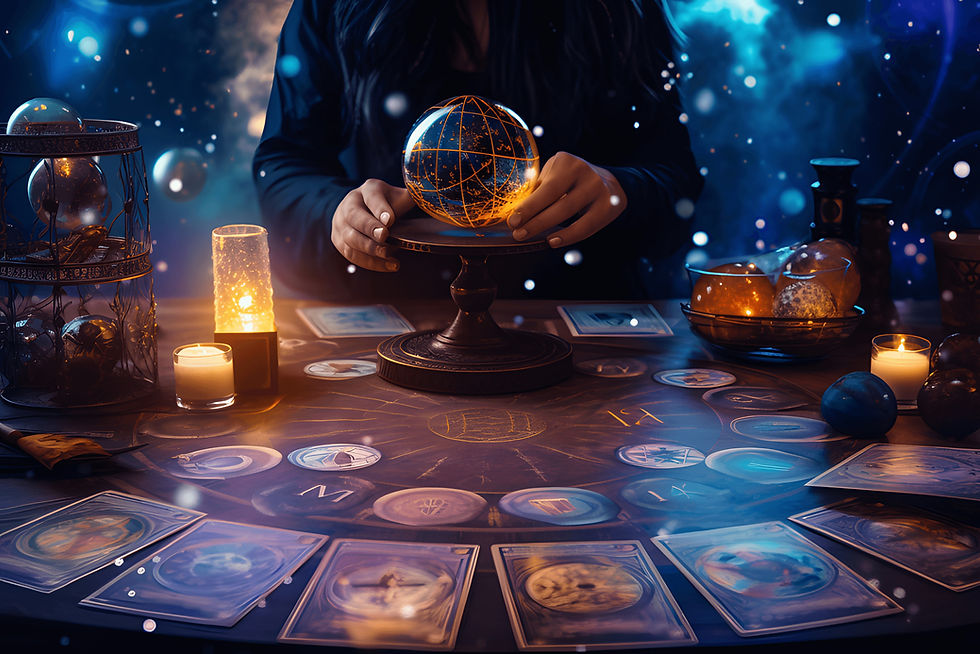
Here is a Tarot spread specifically created for the energy of 2026. Please try the spread out and share your reading with us.


Have a wonderful New Year!

Lara


ree


  • Lara Houston
  • Dec 22, 2025

Updated: Dec 23, 2025

ree

What Tarot Is


Tarot is a deck of symbolic cards

Traditionally made up of 78 cards.

These are divided into the Major Arcana (22 archetypal cards like The Fool, The High Priestess, The Hierophant, etc.) and the Minor Arcana (56 cards arranged in four suits).


A tool for empowerment

Over the years, Tarot has developed into an excellent tool for reflection and insight offering individuals the opportunity to explore their subconscious. This can provide clarity and a way forward in instances where the way ahead may otherwise be fraught with confusion.

Tarot also offers the individual guidance on how to navigate challenges that they may be faced with in life. In this aspect, Tarot can be uniquely empowering.


Each Tarot card speaks its language through the symbolism of each card's imagery.

Archetypes, numbers, elemental associations and astrological correspondences offer a wealth of insight.

This symbolic language links to psychology, philosophy, myth, spirituality, and Numerology and is interpreted via the skill of the Tarot reader.


Tarot is practice with a rich history:

The Tarot’s origins trace back to Renaissance Italy (mid-15th century), where it began as a card game (Tarocchi). Stepping back to the ‘Renaissance’ period in Europe (1400-1700), we see a revival of the interest in ancient philosophy. This revival was especially evident in art and literature, paintings were themed upon this very popular renewal.

During this innovative period, playing cards were introduced to Europe and here is where we begin to connect the past to the present day Tarot.

It was during the1700’s that a man named Etteilla (Jean-Baptiste Alliette) 1738—1791, created the first known divinatory Tarot Deck in 1789.

Its use as a tool for divination and spiritual insight developed much later, in the 18th and 19th centuries.


A flexible, multi faceted medium of divination:

Tarot can be approached spiritually, psychologically, philosophically, or academically.

People use it in meditation, journaling, coaching, spell craft and art—not just insight into what may be coming up for the individual.


ree

What Tarot is Not


Not is not a fixed prophecy:

Tarot doesn’t “predict the future” in an absolute sense. Instead, it offers insights into patterns, possibilities, and energies that may be influencing a situation and how this may 'play out'.


Not a replacement for professional advice

Tarot should not be used as a substitute for medical, legal, or financial advice. It can support reflection and offer insight but should not override professional expertise.


Tarot is not evil

The cards themselves hold no supernatural power—they are ink and paper. Their meaning comes from the reader's interpretation via symbolism, intuition, and the seeker’s engagement.


Not limited to one belief system

Although many associate Tarot with occult or esoteric traditions, it isn’t bound to a single religion or path. People from many spiritual or secular backgrounds use Tarot.


Not about mind-reading

A Tarot reader doesn’t need psychic powers. Reading is about interpretation, empathy, intuition, and symbolic insight—not about reading someone’s thoughts.


Tarot is not to be feared

The superstitions held about Tarot cards are outdated.


Clytie was a beautiful water nymph from Greek Mythology who loved the sun god Apollo (Helios). Unfortunately, her love wasn't reciprocated, so she spent her days looking towards the Sun looking see Apollo riding through the Chariot in the sky,

‘Clytie’, Evelyn De Morgan (1885)

Pamela Colman Smith will have grown up as an artist herself being influenced by the well known artists of her day. It is no surprise that we see several Tarot cards of the Rider Waite Smith deck bearing the sunflower within the imagery.

ree

Vincent Van Gogh painted the 'Sunflowers' in 1888, the painting received much interested and the painter himself reference the flowers as a symbol of happiness.

Christianity liked the sunflower to the faith in God, and the sunflower likened to the Soul, turning to the Sun ( God ) in blind faith.

The story of Clytie and Apollo is quite sad and yet maybe it is more about holding on to hope and seeing the light- which offers a way forward from the dark?

If we look to the Sunflowers on the Waite Smith Sun Tarot card, we see they are positioned on a stone wall. The sunflowers have flourished despite the stony earth bed and lack of an earthly foundation. The seeds are likely to have settled in the cracks in the stone and such is the hope that can be found even in the unlikely places. Such is the strength of the sun, the beauty of nature and birth of the new day.

This certainly reminds me of the Sun Tarot card but can you see an association with other Rider Waite cards?

If so, which ones and why?

Tarot card, the Sun by Pamela Coleman Smith 1909


bottom of page